
From Bondage to the Battlefield
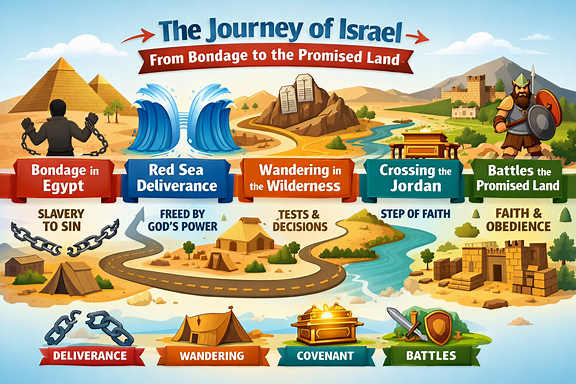
The story of Israel's journey from Egypt to the Promised Land is more than ancient history. It is a powerful picture of the spiritual journey every believer must take.
Throughout Scripture, God often uses real events to illustrate deeper spiritual truths. Israel's deliverance from Egypt provides a remarkable illustration of humanity's condition, God's provision of salvation, and the choices each person must make in responding to Him.
Egypt: A Picture of Bondage to Sin
In biblical typology, Egypt represents the world and humanity's bondage to sin.
The Israelites were slaves. They could not free themselves. They were trapped under the power of Pharaoh and had no way of escape.
Likewise, every person is born into a world enslaved by sin. We may not recognize our condition, but apart from God we are in spiritual bondage and unable to save ourselves.
Just as Israel needed a deliverer, humanity needs a Savior.
The Passover Lamb: God's Provision for Deliverance
God provided a way out for Israel through the Passover lamb.
For Christians, this points directly to Jesus Christ, the Lamb of God who takes away the sin of the world.
Through His sacrificial death, Christ made salvation available to all people. He broke the power of sin and opened the door to freedom.
Yet the provision of salvation is not the same as personally receiving it. Christ died for all, but each individual must respond to His offer of grace.
The Wilderness: A Place of Decision
After crossing the Red Sea, Israel was no longer enslaved in Egypt.
They had been delivered from bondage, yet they had not entered the Promised Land.
In the wilderness they received God's law at Mount Sinai. They learned His ways and were given the opportunity to obey Him. However, obedience remained a choice.
The wilderness became a place of testing, learning, and decision-making.
In a similar way, many people recognize the truth about God and understand the gospel, yet remain undecided about fully committing themselves to Christ.
The wilderness reminds us that knowing about God's provision is not the same as embracing it.
The Jordan River: Crossing Into Faith
Eventually Israel arrived at the Jordan River.
Ahead of them stood the Promised Land—a land God had promised to give them. Yet entering it required faith.
The people sent spies into the land. Although the land was good, most of the spies focused on the giants and obstacles rather than God's promises.
Fear overcame faith.
As a result, the people refused to enter.
This illustrates a spiritual reality. Many people hear God's invitation but allow fear, doubt, or unbelief to keep them from fully trusting Him.
The crossing of the Jordan represents a personal response to God's offer of salvation.
When the priests carrying the Ark of the Covenant stepped into the river, the waters parted and the people crossed over.
The Ark symbolized the presence of God. God's presence made the way possible.
Likewise, salvation is not achieved through human effort. God Himself provides the way.
Why the Promised Land Cannot Represent Heaven
Many people assume the Promised Land symbolizes heaven. However, several details suggest otherwise.
In the Promised Land there were:
Giants
Battles
Temptations
Enemies
Spiritual dangers
None of these exist in heaven.
The Promised Land is better understood as a picture of the believer's life of faith and obedience after embracing God's salvation.
It represents walking in God's promises while still living in a fallen world.
Believers continue to face battles, temptations, and challenges, but they do so while enjoying God's presence and provision.
Covenant Commitment and Public Identification
After crossing the Jordan, Israel renewed its covenant relationship with God.
The men were circumcised, signifying their commitment to the covenant.
In the Christian life, baptism serves a similar purpose.
Baptism does not save us, but it publicly identifies us with Christ and declares our commitment to follow Him.
Just as Israel openly renewed its covenant with God, believers publicly testify to their faith through baptism.
Jericho: Victory Comes Through Obedience
The first major challenge in the Promised Land was Jericho.
God gave specific instructions for its conquest. Victory would come only through obedience.
When the walls fell, the people were instructed not to take the spoils for themselves.
However, Achan disobeyed God's command and secretly kept forbidden items.
His sin brought judgment.
The lesson is clear: entering into a relationship with God does not eliminate the need for obedience.
Faith and obedience must go hand in hand.
Rahab and Achan: A Lesson About True Faith
Two individuals stand in sharp contrast during Israel's conquest of Jericho.
Rahab
Rahab was a Gentile living in Jericho.
Yet she believed in the God of Israel. Her faith led her to protect the spies, and she and her family were spared.
Achan
Achan was an Israelite.
Yet despite belonging to God's covenant people, he chose disobedience and suffered judgment.
Together these stories teach an important truth:
Outward identity alone does not guarantee a right relationship with God.
Faith matters.
Obedience matters.
A person is not accepted by God merely because of family background, religious affiliation, or external labels.
A Warning for Modern Christians
The same danger exists today.
Someone may grow up in a Christian home, attend church regularly, and call themselves a Christian. Yet a title alone does not create a genuine relationship with Christ.
On the other hand, a person who has spent years far from God can come to faith in Jesus and become a true believer.
God looks beyond labels and examines the heart.
The question is not, "What group do I belong to?"
The question is, "Have I personally trusted and followed Christ?"
Conclusion
Israel's journey from Egypt to the Promised Land provides a vivid picture of the Christian life.
Egypt reminds us of our bondage to sin.
The Passover lamb points us to Christ's sacrifice.
The wilderness illustrates the place of decision and testing.
The Jordan represents a response of faith.
The Promised Land pictures a life of walking with God amid real battles and real blessings.
And throughout the journey, one truth remains constant: God's promises are available to all, but each person must respond in faith and obedience.
The question every person must answer is the same one Israel faced at the Jordan River: Will I trust God's promise enough to step forward in faith? A lot of times it’s hard to see what a section might look like on your website. This paragraph is to help give you a feeling for it. Replace this text with your own.
Next Steps
Continue to explore the faith life of our church including our other ministries, upcoming events, and service opportunities.